
The Two Pillars of Sustainable Lead Generation
Referrals are good. They are not a system.
Many founder-led B2B service firms in Australia and New Zealand run on referrals, or on one person who knows everyone. That feels fine until it doesn’t. One dry quarter, one key person leaving and the pipeline empties. The work is strong. The firm just cannot say where next month’s meetings will come from.
Referrals are worth having. The problem is treating them as a system. A system is something you can see, measure and repeat on a Tuesday when nobody has called.
Here is the cost of leaving it that way. Revenue swings with a few relationships. Quiet months get filled with worry instead of work. You hesitate to hire, because you cannot see the pipeline that would pay for the hire. What you want is predictable growth you can plan around, without becoming a full-time salesperson. What stops a firm is rarely effort. It is that nobody has built the thing between “good at the work” and “known by the right buyers”.
The reason to change now is simple. The referral well does not get deeper as you grow. It stays the same size while your costs rise. The longer the firm waits, the more it depends on luck at exactly the moment it can least afford it.
Two pillars fix this. In order: get commercially clear, then build an engine you own.
Pillar 1: Get commercially clear before you spend on leads
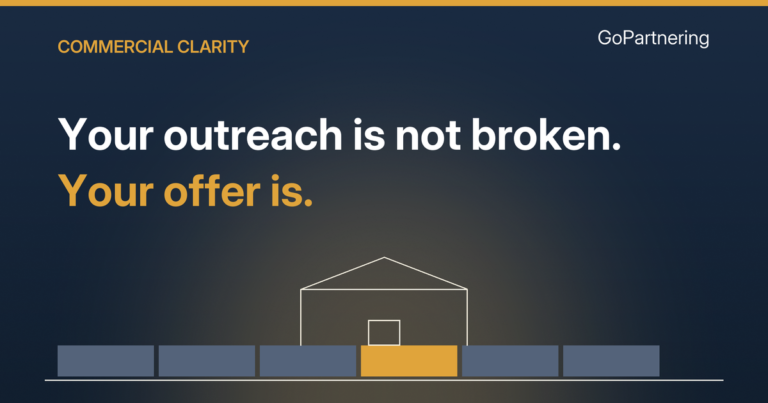
Before you spend a dollar on outreach, you need to know exactly who you are talking to and why they should care. Founders often nod along and skip straight to tactics. I have seen firms with genuinely excellent services and muddled positioning. More outreach did not fix it. It amplified the confusion.
Commercial clarity means getting honest about 3 things.
- Who is your buyer, precisely? Not “mid-size businesses”. The actual person reading your message at 7am before a meeting. What keeps them up, and what words do they use when frustrated?
- Does your offer land? The only test is real conversations. Listen to your sales calls. If the same objection keeps coming up, fix the offer before you scale the outreach.
- Can you say it in one breath? If it takes 3 sentences to get going, the message is not ready. A tight proposition attracts the right buyers and quietly repels the wrong ones.
A quick test. Pick your last 3 sales conversations and write down, in the buyer’s words, why they said yes or no. If you cannot, you do not yet have the raw material for a message. That gap is the first thing to close, and it costs nothing but an hour.
Clarity is not a one-off exercise. It sharpens with real feedback. But you need a baseline before you build anything on top of it.
Pillar 2: Build a lead engine you own, not one you rent
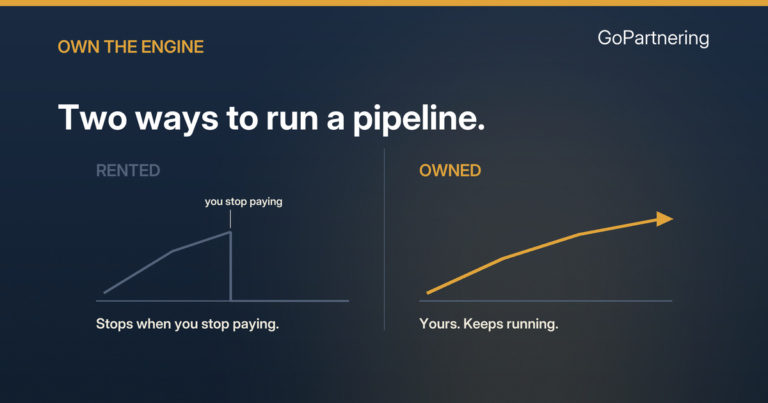
With an agency, you typically get activity reports and a monthly invoice, but little sight of what is working or why. The accounts, data, sequences and contacts sit with someone else. When you stop paying, you start again from zero.
Owning is different. You hold full access to your engine, your data, your workflows and your results. GoPartnering maintains and improves the baseline underneath for a monthly infrastructure fee. That is still owning. You carry none of the maintenance work, and you keep the engine, the data and the access whatever happens to the relationship.
This is the part agencies rarely explain. The sequences, the targeting and the data are the asset. If they live in someone else’s account, you are renting your own pipeline. The rent goes up the moment you depend on it.
A GoPartnering build runs about 90 days, and you are inside it from week one. Outreach decisions get made from your own data. When the market shifts, you adapt without waiting on an account manager or renegotiating scope.
EverCert, an ISO and HSEQ compliance consultancy, is one example, named with the consent of its managing director Steve Ebejer. They reported a first qualified meeting in about 4 weeks. Their annual lead generation cost moved from about A$30,000 a year to an estimated A$14,990 after handover. That is one client’s reported outcome, the cost figure is an estimate and it is not a promise.
What this will not do
It will not work for everyone. If your offer does not land with real buyers, outreach will not rescue it. The honest answer after a first conversation can be “not yet” or “not for you”. Results depend on your market, your offer and your consistency. Better to find that out early and cheaply. A founder who learns in 45 minutes that the offer needs work has saved months of outreach spend. A founder who learns it after 6 months of sequences has not.
3 pitfalls even good foundations hit
- Ignoring the data. Reply rates and meeting conversions tell you what is working. Outreach produces signals constantly. Review them weekly, or you repeat weak sequences for months. Ask one question each week: what did the numbers tell us, and what are we changing?
- Sporadic effort. A week of activity then 3 weeks of silence builds frustration, not momentum. Treat outreach as a standing commitment, not a project you return to when things get quiet.
- Digital only. A well-timed phone call or a coffee that is not about selling still wins deals. Keep room for human contact, because digital outreach opens doors and people close them.
Where most of the value sits
The 2 pillars depend on each other. Clarity without an engine gives you a sharp message and nobody to send it to. An engine without clarity gives you activity, reports and no meetings. Both together give you something a founder can lean on: a known buyer, a message that lands, a repeatable way to reach them and full access to the lot.
Practical checklist
- Define your ideal client with enough detail to write a single name in the blank.
- Research your audience through real conversations, not just desk research.
- Test your offer before scaling outreach.
- Get your value proposition to one-breath clarity.
- Set a weekly outreach rhythm and protect it.
- Review your metrics weekly and act on what they show.
- Balance digital outreach with direct personal contact.
The next step is a conversation with me
Founders who own their engine do not just spend less. They grow with more confidence, because they can see what is working. If you want to know whether your offer is clear enough to build on, I will run a TrueMark session with you myself. It is a 45 minute working session where we pin down your buyer, your offer and your one-breath pitch. You leave with a clear read on whether to build, fix or wait. It is free for the first 10 clients. Book it at gopartnering.com/truemark.
There is no pitch at the end of it and no obligation to build anything. If the answer is to fix the offer first, I will say so plainly.
Next step
Find the biggest leak in how your firm wins new business
The Owned Growth Scorecard takes two minutes. Eight questions, one score, and the first move to make. Built for founder-led B2B service firms.
Take the scorecard Or book a free Readiness Check with Mikael