Your Outreach Is Not Broken, Your Offer Is
Most founders I talk to are convinced they have a targeting problem. Or a volume problem. Or a timing problem.
They rarely think they have an offer problem.
But when replies start thinning out and every new batch of outreach performs worse than the last, the issue is almost never that you need to send more. The issue is that what you are sending does not land. And it does not land because the commercial clarity behind the offer was never razor sharp enough for cold outreach in the first place.
This post breaks down the three things a founder has to get clear in their offer before scaling outreach can ever pay off.
Table of Contents
ToggleWhat you will walk away with
- The five diagnostic questions that expose whether your offer has real commercial clarity
- Why “I can work with anyone” is the most expensive sentence a founder can say
- The three elements (intent, timing, message) that make outreach actually convert
- Why the hardest part of fixing outreach has nothing to do with outreach
The five questions that expose everything
When a founder comes to me with thinning replies, I do not look at their sequences first. I do not look at their targeting lists. I do not look at their subject lines.
I ask five questions.
- Do you know the current pains of your target audience?
- Do you know the desired outcome of your target audience?
- What is stopping them from getting there?
- What is motivating them to change?
- Is your business ready to provide this?
These are not clever coaching questions. They are diagnostic tools. And the answers, or the lack of answers, reveal everything about whether the offer is ready for outreach or not.
When we address these questions in a TrueMark session, it is often very clear when a founder does not know the answer or has thin answers. We are talking human to human in that room. No slides. No frameworks on a screen. Just a conversation that pushes the founder to the wall. And in that setting, it becomes obvious to the founder themselves whether the commercial clarity is actually there.
You cannot fake depth in a live conversation. That is why surface-level responses do not survive the process. The follow-up questions keep going until we hit something real or we hit a wall. Both outcomes are useful. One tells us what to build on. The other tells us what to fix first.
But here is where it gets uncomfortable for most founders.
“I can work with anyone” is the most expensive sentence in B2B
One of the most significant examples I have seen lately came from a TrueMark session with a founder who genuinely believed he had commercial clarity.
I walked him through his own story. He had customer one, prospect two, customer three. Three different businesses, three different profiles. I asked him a simple question.
Which one of these three businesses would you like to see ten times more of?
His answer: “I can work with anyone.”
For me, that is a clear reveal. Clarity is missing in the commercial structure.
Not that everything is bad. Not that the business is broken. But we have to understand that commercial clarity, especially in cold outreach and any type of online digital marketing, needs to be crystal clear and razor sharp for your target audience. “I can work with anyone” is the opposite of razor sharp. It is a fog machine pointed at the people you most need to reach.
When your offer tries to speak to everyone, it resonates with no one. The prospect scanning their inbox or their LinkedIn messages in between meetings does not have the time or the patience to figure out whether your offer applies to them. That is your job. And if you have not done that work, no amount of volume fixes it.
Here is what the most common founder phrases actually mean, and what to do about each one.
| What founders say | What it actually means | What needs to happen |
|---|---|---|
| “I can work with anyone” | No clear ideal client profile | Define the one client you want ten times more of |
| “We offer end-to-end solutions” | The offer is too broad to land in cold outreach | Narrow to the specific pain and outcome that resonates |
| “Our messaging is fine, we just need more volume” | The message has not been tested against real audience language | Rebuild messaging using the words your audience actually uses |
| “We’ve tried everything” | Multiple tactics, zero commercial foundation | Stop all outreach and run a clarity session first |
This is where the real resistance begins.
The language gap most founders cannot see
When I first see a founder scaling outreach without getting better replies, the thing they are most blind to is almost always the same.
They are not speaking the language of their target audience.
They are using their own words. Their own expressions. Their own internal framing of what they do and why it matters. And they assume those words land the same way on the other side.
They do not.
Words are not just words in outreach
The words and expressions that truly resonate with a target audience are often different from the ones the founder uses internally. Sometimes subtly different. Sometimes completely different. And behind that language gap, there is often something deeper: the offer itself may need adjustment for a greater market fit.
Because if the offer is not really a good fit for the current market, no words or messages can change that. You can polish the language all you want. You can A/B test subject lines until you run out of variations. But if the underlying offer does not match what the market actually needs right now, the outreach will keep thinning out.
This is why I always say clarity before activity. The language problem and the market fit problem are connected. Fix the clarity, and the language often follows naturally. Skip the clarity work, and you are just rearranging words on a sinking ship.
So what does outreach actually need to work?
Intent, timing and message: the three things that make outreach land
I had to tell a founder recently that his outreach was not working because he was using what I call spray and pray.
Massive amounts of outreach and engagement hooks thrown into the digital world. But people were not getting it. Not because they were not seeing it. Because it was not consistent, not clear and not reaching the right people.
Instead of spraying and praying, I suggested three things.
1. Intent is the leverage
The intent of a prospect is the leverage that makes your offer and your outreach work. Not your intent. Theirs. What are they actively trying to solve? What are they already looking for? If you cannot answer that with specificity, you are guessing. And guessing at scale is just expensive guessing.
Hyper-targeting is the new leverage. When you understand the intent behind a prospect’s current situation, you can craft outreach that feels like it was written for them. Because it was.
2. Timing is the multiplier
The second element is timing. Even a razor sharp message sent to the wrong person at the wrong moment gets ignored. But when you combine clear intent signals with the right timing, the same message that got zero replies suddenly starts conversations.
Timing is not luck. It is a function of knowing your audience well enough to recognise when they are in motion.
3. Message and clarity is the delivery
The third element is the message itself, built on top of the clarity work. Not clever copywriting. Not persuasion tricks. Clear, direct communication that tells the prospect: I understand your problem, I know the outcome you want, and here is why this is worth a conversation.
When all three align, outreach stops feeling like outreach to the person receiving it. It feels like relevance.
But getting to that point requires the work most founders resist.
The foundation nobody wants to build
The biggest resistance we find is not about tactics or tools. It is about spending the time, energy and money to refine and improve the offer. To make sure it is on point and clear for the target audience with a great market fit.
Because spending that time, energy and money does not feel like you are getting something.
It is not like buying a car where you step in and turn the key. This is work that mostly goes on inside the mind. Clarity. Thinking. Analysing. Testing assumptions against reality.
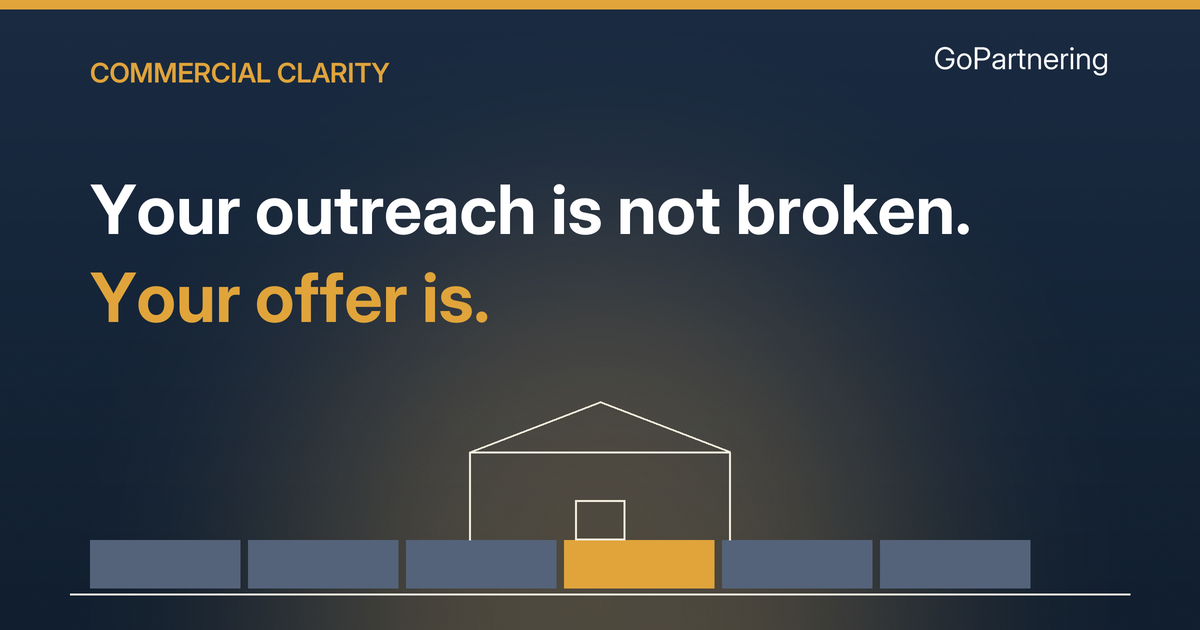
It is like building the grey brick foundation in the ground before you build the house. It is boring. It is sometimes a little bit expensive. And it does not give you much to show for it in the short term.
But if you do not build the foundation right, the house will fall.
- You cannot scale outreach on a vague offer
- You cannot fix reply rates with volume when the message does not resonate
- You cannot bypass commercial clarity with better automation
Every founder who has sat through a TrueMark session and done the hard thinking has come out the other side with something they did not have before: the ability to answer three questions without hesitation.
What are you selling? Who are you selling to? And why should they care?
If you cannot answer those in one breath, with specificity, without hedging, the outreach is not the problem. The offer is. And no amount of scaling will fix what was never clear enough to land.
Where to start
If you got to the end of this and could not answer those three questions in one breath, that is not a failure. It is the most useful thing you can know right now. It means the next move is not more outreach. It is clarity.
That is what a TrueMark session is built to do. One structured conversation, human to human, that pressure-tests whether your commercial clarity is really there and shows you what to fix first.
If that is where you are, book a free Readiness Check or send me a DM on LinkedIn and we will work through it together.
And if you want this kind of thinking every fortnight, subscribe to the newsletter and I will send the next one straight to you.
Next step
Find the biggest leak in how your firm wins new business
The Owned Growth Scorecard takes two minutes. Eight questions, one score, and the first move to make. Built for founder-led B2B service firms.
Take the scorecard Or book a free Readiness Check with Mikael